

Abstract
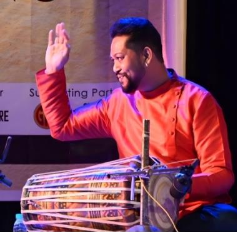
This essay explores the vibrant and culturally significant folk music traditions of the Indian Himalayan region, with a focus on Sikkim, Darjeeling, and Kalimpong. Central to this study are three key elements of Indian Nepali folk heritage: Shreemaadal, Maadalay Geet, and Maaruni Naach. Together, these represent a holistic form of musical expression consistent with the Indian classical concept of “Geetam Vaadyam Tathaa Nrityam Trayam Sangeetam Uchyate,” wherein vocal music, instrumental accompaniment, and dance are integrally combined. Of these, the Shreemaadal—a barrel- shaped leather drum akin to the Pakhawaj—emerges as the primary percussion instrument, grounding performances with its rich, resonant rhythm. The study also highlights the Paschimey Maadal, a smaller, high-pitched Nepali drum used widely in folk and film music. Though centered on Indian Nepali traditions, the work also touches upon the musical expressions of the Bhutia and Lepcha communities, framing all within a broader ethnomusicological lens. Drawing from ethnography, linguistics, and musicology, the research emphasizes how these traditions sustain cultural identity, foster intergenerational transmission, and strengthen community bonds. This study reaffirms the importance of preserving these traditions as part of India’s intangible cultural heritage.
References
Bharata Muni. The Nāṭyaśāstra (Two Vol.). Translated by Manomohan Ghosh. Calcutta: Asiatic Society, 1957.
Acharya Brihaspati. Traditional Theories on Mridanga. Ancient Vedic Commentaries, Post-Vedic Period.
Gurung, Tek Bahadur. The Art of Gorkha Folk Music. Darjeeling: Gorkha Cultural Forum, 2012.
Kothari, Komal, and Shubha Chaudhuri. Kalbeliya: The Heritage of the Snake Charmers. New Delhi: Sangeet Natak Akademi, 1995.
Narada. Sangeet Makarand. Translated by L.V. Natarajan. Chennai: Classical Traditions Press, 1978.
Padhy, Sushil. Cultural Heritage of the Indian Nepali Community in Sikkim. Gangtok: Sikkim Cultural Academy, 2011.
Parapanje, V. S. Mridang aur Uski Kala. New Delhi: Sangeet Natak Akademi, 1968.
Pradhan, L. B. History of Nepali Music and Culture in India. Kathmandu: Himalaya Publications, 1999.
Regmi, Mahesh Chandra. Land Tenure and Taxation in Nepal. Kathmandu: Regmi Research Institute, 1978.
The Rig-Veda: The Sacred Books of the East (Vol. 5). Translated by Max Müller. Oxford: Clarendon Press, 1889.
Rose, Leo E. Nepal: Strategy for Survival. Berkeley: University of California Press, 1971.
Singh Kaajee, Vidyaarthee. Maadal: Shri Hari Krishna Singh Gazmer. Darjeeling, 1974.
Singh Kaajee, Vidyaarthee. Shreemaadal – Shaastreeya Evam Vyavaharik Paksha. Kalimpong: Samskriti Samrakshan Samsthaan, 2014.
Singh, R. D. Folk Traditions of Sikkim and Darjeeling. New Delhi: Indian Cultural Research Foundation, 2003.
Stiller, Ludwig F. The Rise of the House of Gorkha. Patna: Patna Jesuit Society, 1973.
Vasudev Shastri. Sangeet Mridanga, Vol. 65. Various regional editions, 19th century.
Whelpton, John. A History of Nepal. Cambridge: Cambridge University Press, 2005.