

Music, fastidious grammarians aver, should be treated as an uncountable noun. And it is largely so! But should the people who know a thing or two or more about mountain music accept the diktat of those grammarians? No, perhaps. Mountains have musics of their own. The trees play, the brooks sing, the breezes flowing in many directions intone, and there is the orchestration of birds and animals, separately and together. One would call them the ‘musics’ of mountains. But that is not the end of the repertoire of mountain ‘musics’. There could be and are many more ‘musics’ belonging to mountains, heard and even unheard. There are those ‘musics’ too, that the humans dwelling in mountains for generations have been making; and they are the ‘musics’ of varying kinds, inspired and enlivened by the several and various ‘musics’ of mountains. And we would call and identify them, a little differently, as the ‘musics’ in mountains. These ‘musics’ in mountains replicate, in several subtle ways, the ‘musics’ of mountains.
Thinking and writing in the context of the entire extended family of the mountain ranges of the Himalayas, stretching from almost beyond Afghanistan in the west to deep inside Myanmar in the east, the number of musics in mountains is so huge that any inclusive study of those musics can fill the pages of a series of volumes on Himalayan musicology. Himalayan musics too alter, as the geographies and the terrains and the cultures and the languages alter along that stretch across a big part of the Asian continent from the west to the east.
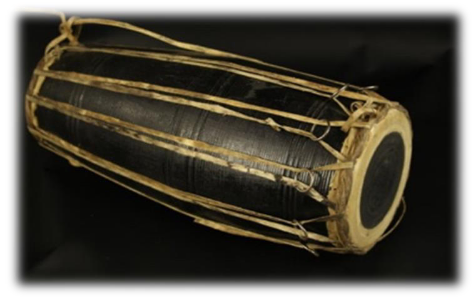
The Hill Cultures section of this issue of Caesurae: Poetics of Cultural Translation (Vol 6:2) has Musics of the Himalayas as its broad theme. The feature essay in the section brings to us an in-depth glimpse of the varieties of traditional music created and majorly practiced by a group of the communities of people belonging to and living in the regions of Sikkim, Darjeeling and Kalimpong, which are the regions right at the start of Eastern Himalayas moving west to east. Written by Nishaant Singh, the essay makes a close analysis of the nuances of the music of Shreemadal, a traditional percussion instrument, and its symbiotically central role in Mandalay Geet (a family of folk songs) and in Maaruni Naach (a form of folk dance). The essay by Sachin Limbu is another piece located in the same geographical region of Eastern Himalayas. The essay doesn’t directly concern the theme of music. Titled “Revisiting Priesthood System of Limbu Community”, the essay analyses the core religious-cultural practices of the people of Limbu community in the region. That core, as the essay explains, has its ultimate source of inspiration and interpretation in the Mundhum, which contains the philosophical foundations of the practices of Limbu communities and which has travelled from generation to generation in oral form, basically rhyming and poetic in character. Music, thus, is an essential constituent element of the Mundhum and all that it envisages and communicates. The third piece in the section is a short essay by Lincoln Murasingh, titled “Rhythms of Tripura Hills”; and it explains the major dances of the indigenous community of Tripuri people living in the tiny eastern Himalayan state of Tripura bordering Bangladesh on the east.
We do hope that the essays in the section add much to our understanding of the musics in mountains.